
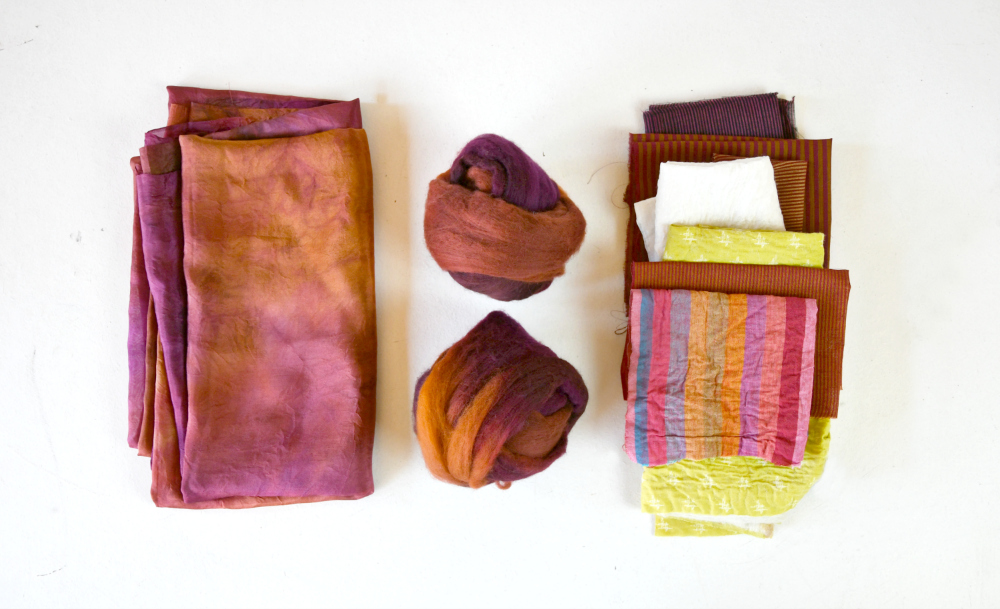
Felt Capelet Online Workshop: Materials List
Please do email me if you have any questions about any of the items, for sources and possible substitutions.
Fibres and materials:
This list includes the materials you will need to do the basic construction. I’ve been as specific as possible, to be clear on what you will need, but I do encourage your exploration and creativity! You can work with any design features you wish, including any of the techniques from Surface Design Online, Felting Over the Edge or Ink on Cloth, and any materials you need for this further embellishment will be extra to this list.
If you are new to garment making, and felting, I suggest you keep your colour selection simple and focus on the construction. Work with coordinating wool and silk fabric colours, and then use a contrast colour on the second side, and for embellishments.
Wool and Cloth:
- 4.0 ounces/115 grams extra fine merino roving, 19 micron or less
- 2.7 yards/ 2.5 metres silk habotai/china silk/paj/ponge silk (4-5 momme) if the fabric is 45″ (115 cm) wide
- 2 buttons (0.75- 1.25 inch / 2.0-3.0 cm), or snaps, plus snap tool.
- Embellishment materials: The surface embellishments shown in these instructions include small pieces of silk fabrics, plus wool, nuno and exotic fibre prefelts. Instructions for making these prefelts are included in the class. You could also use wool details, ramie fringes, or ramie, silk or bamboo fibres for surface embellishment.
You can make the capelet from wool only, or make it as a nuno felted project. The instructions take you through making this as a nuno felted piece, but you can always skip those steps and materials to work with wool only.
Resist Material
- Resist material: approximately 48” x 29” (122cm x 74cm) lightweight, laminate floor underlay works best. You can use a medium weight painters plastic (3.0-3.5mil), And silver duct tape. We’ll use the duct tape to trim all the sides, folded over the edge. Be sure the duct tape is the woven kind, not the stretchy kind.
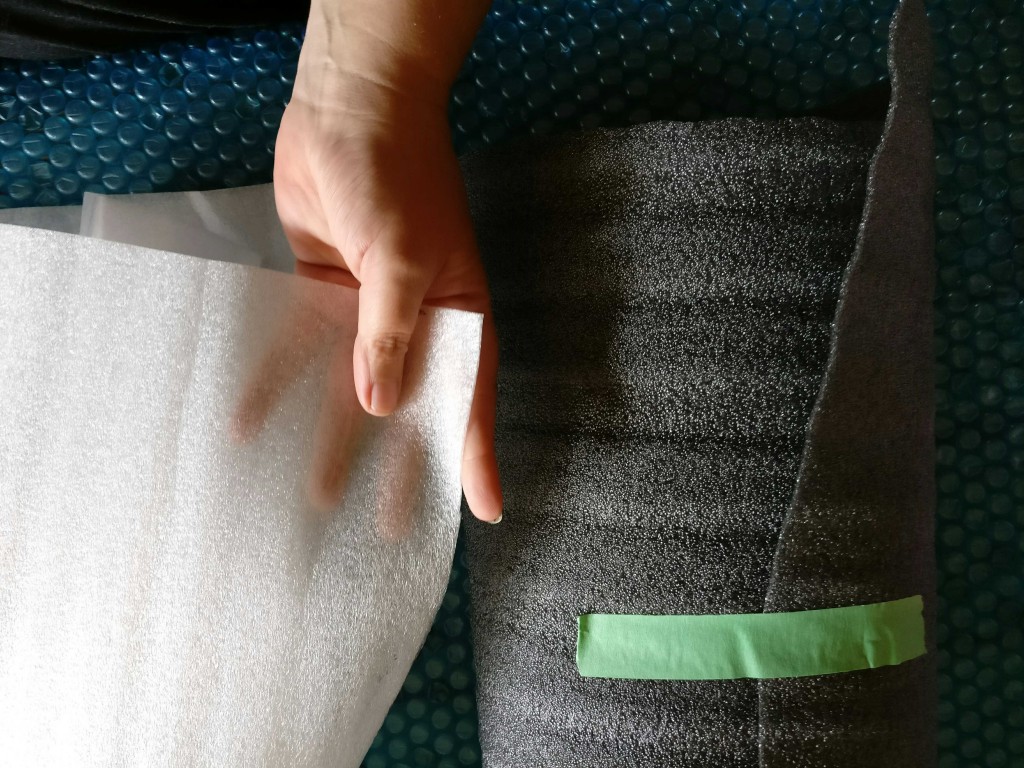
Laminate floor underlay (shown above), or a medium weight painters plastic (3.0-3.5mil) (shown below) and silver duct tape.

- Small amount of thin plastic sheeting- 12” x 12” (30 x 30cm). This could be painters dropcloth plastic, or cut from a shopping bag/rubbish bag
Tools and Hardware
- Work Table: Table for workspace: 30″ (76 cm) x 96″ (243 cm)- a standard 2.5 ft x 8 ft folding table is ideal. You’ll be able to see the full layout. You can also work on a shorter table, and we’ll scroll the work, laying it out in sections, and then rolling it up to work on the next section.
You can work on any work surface. This table size is given only as a suggestion, as they are very readily available, very inexpensive, and can be stored away easily, in between uses. You can work on a dining room or kitchen table, with a protective plastic layer, or a smaller table with a sheet of plywood on top, or you can work on the floor if your personal flexibility and stamina allow!
Non Slip Rubber Grip Mat/Bubble Wrap:
- 1 piece rubber grip mat: between 36″ (90cm)- 48″(122cm) x 60 inches (150 cm)-if you have a longer piece from the Versatile Vest Class or other projects, that will also be fine! Keep the piece of grip mat at it’s full length!
- 1 package of painters drop cloth
or
- bubblewrap: 2 pieces each, 36 inches (90 cm) x 60 inches (150 cm). Bubblewrap section can always be taped together, as needed.
Here’s some more information on these two options:
I strongly suggest you work with rubber grip mat for these projects. It is very light to work with, speeds up the felting process significantly and produces a very tight felt.
You can always get a larger single mat, and cut the piece for this class from it, and then also have smaller pieces to work with for smaller projects. You can find these for about $25 or less for this size, and this is an absolutely worthwhile purchase! You can use this for all felting projects other than paper felt. You definitely want to get the most flat rubber mat- not the knobby one, as the little knobs will break off over time.
If working with the grip mat, you will also need 1 package of painters drop cloth– thin plastic used as drop sheets. You’ll find this in most hardware stores or building supply centres.
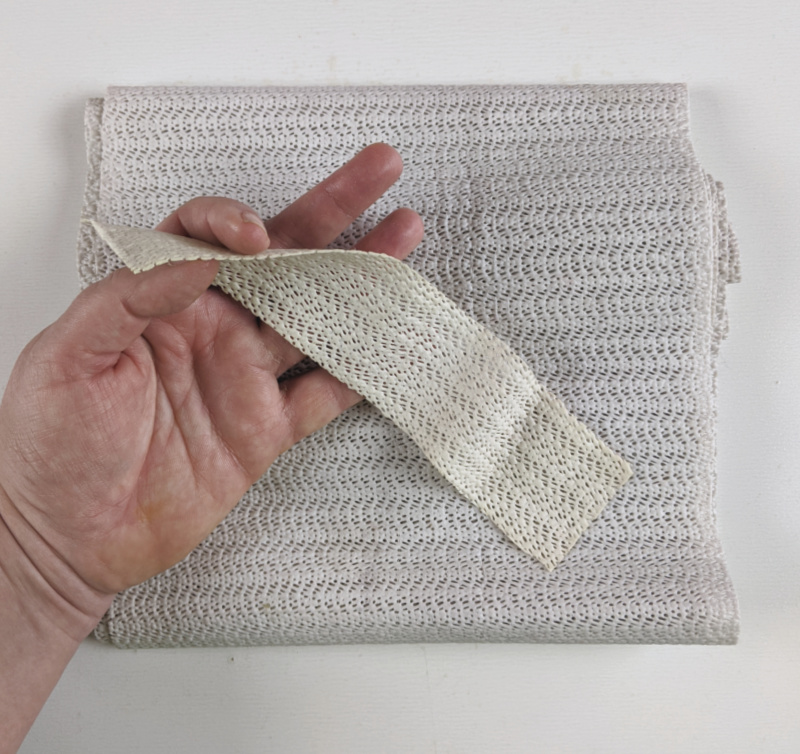
This grip mat is sold as non slip rug underlay. I suggest using the thin, more flat one with a more woven appearance. The other style you might see looks more like a grid and is thicker. it does work well, but the little bobbles of the grid can start to break off over time. The thin flat one is excellent and really should never need to be replaced. It’s good to have a few pieces in different sizes to keep it more manageable. I suggest planning out what sizes or worksurface you most often need or use. Like a smaller square for vessels, a thinner long panel for scarves and a large rectangle for garment, for example. Then work out what single size of the grip mat you could get that will allow you to cut out those various sized pieces from one large piece.
If you are working with grip mat, Layout your work surface in this order:
grip mat
layer of thin plastic
fabric and felt layout as usual
layer of thin plastic
Once everything is well attached and starting to shrink, you will remove the light plastic (this can be reused in future projects) and work with the felt directly in the grip mat. Even in the late stages of fulling, when I am rolling the felt on itself, will work on top of the grip mat, but I will also often roll it in the grip mat some more, especially with a length of pipe in the centre for firm rolling.
OR! You can instead use bubblewrap: 2 pieces each, 36 inches (90 cm) x 60 inches (150cm). Bubblewrap sections can always be taped together, as needed.
It is absolutely fine to use the work surface of your choice- grip mat, bubble wrap, netting… The instructions will all refer to bubblewrap and grip mat, but you can work with the felting surface of your choice.)
- Pool noodle, pipe or dowel: pool noodle or 36″ (90 cm) length of 1.5″ (3,8 cm) diameter PVC pipe (if you make your table risers from this-you’ll have about this length left from an 8 ft (240 cm) length of pipe), or 36 inch (90 cm) length of one inch diameter wooden dowel. You will only need one of these items. It is for rolling up the work initially, and rolling over the top of the work. The pool noodle will work well, but I prefer the firmness of the pipe or dowel for rolling. A wooden dowel, inserted into the centre of a pool noodle, is another excellent option.
- Natural liquid dish soap or dish detergent (like Seventh Generation or Nature Clean)
- Ball brause or other tool to wet out your felt
- Small bucket for felting solution
- Table risers– this will make your layout and felting time so much easier on your body. Look for bed risers at home accessories shops, or cut four 16 ” (40 cm) lengths of PVC pipe, that slide over the table legs. The length and diameter of pipe will depend on your style of table, where the bend is in the leg, and your desired work height- which will be at about counter height.
- Sharp pointed scissors
- Sewing pins
- Measuring tape
- Calculator
- Notebook and pen/pencil
- 2-3 old towels
I suggest you get the best quality of materials you can. In felting, our greatest investment is our time. In making something handcrafted, it is already precious. We don’t use huge amounts of materials and produce almost zero waste. Always chose the very best materials you can afford. It is a small cost relative to the value of your time that you will put into the piece. Good quality materials will give you a better finish and end result. It’s worth it!
Contact me if you have any questions about materials and suppliers.